
The Ponzi's Ponzi scheme
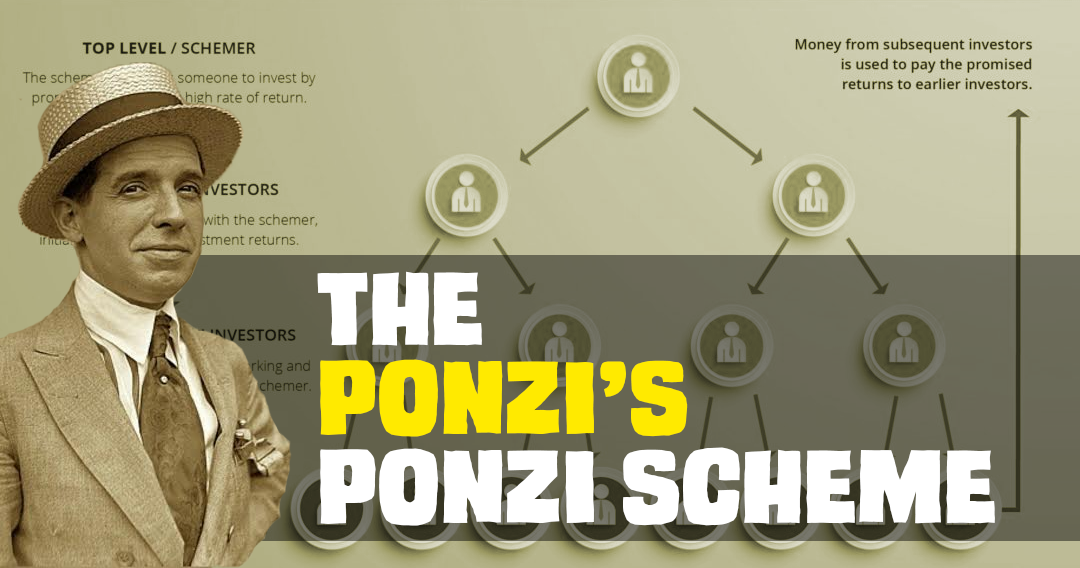
In 1903, the 21-year-old Charles Ponzi boarded the S.S.Vancouver to travel to America. With charisma and confidence, three dollars in his pocket, and “$1 million in hope”, he set out to change the world. For the next few years, Ponzi’s life was eventful, but for all the wrong reason. He worked as a dishwasher at a restaurant, then as a waiter, until he got sacked for theft. He went to Montreal, Canada, where he got himself in a bank fraud, ending up with three years in jail. After his release in 1911, he travelled back to the U.S and found himself smuggling Italians through the border, which led to two more years behind bars.
During his time working at the Canadian bank, he found out that the bank was in serious financial loans, and that his manager would talk people into depositing their money at a 6% interest rate, then pay them back not with profits from the bank’s investments, but from deposits buy newly-opened account. This gave Ponzi a bright idea; an idea that would bring him $8 million later on.
To give you a brief context of history: World War I ended in 1918; the American economy was blooming thanks to weapon trades throughout the war, and many from all over the world were crossing the Atlantic to come to the U.S in the hope of realizing ‘the American dream’. To do this, lots of people had to leave behind their spouses, their parents, or even their children. The only means of overseas communication was indeed, paper mail. At the time, International Reply Coupon (IRC) was very popular, which was often enclosed in the mail by the sender so that the recipient could trade it into stamps to write back without extra cost. As the price for stamps in America was higher than in European countries, an IRC bought in Italy would have a very low price, but in turn could be redeemed in the U.S. into stamps that were worth much more. In theory, there was potential profit.
Ponzi brought this idea forward to his friends and relatives. He set up the Securities Exchange Company (SEC) in Boston where he persuaded his investors to put their money into his company, promising promise 150% of cash in return in a very short period of time. Many bought the idea, started pouring their own savings into the company’s business in the hope of becoming rich effortlessly.
Of course, buying and selling stamps was not what Ponzi had been having in mind. His plan was simple: establish a company that calls for investors’ funding, promise 150% of cash in return, then find two new investors to fill it up, keeping the remaining 50% for himself. In other words, Ponzi was “robbing Peter to pay Paul”. Moreover, whoever cashed out early and found out that their money had actually doubled decided to re-invest. The more an investor spent, the more money Ponzi could potentially pocket, not to mention all the word-of-mouth from investors themselves, who brought in even more people to join the bandwagon. Soon enough, Ponzi was looking at six-digit figures.
Anyone with a straight mind would know that such model would not work. With one investor at level 1, there would be 16 investors at level 5, and 512 investors at level 10. The further it went down the scheme, the more difficult it would be for one to find enough investors. In Ponzi’s case, however, this worked. Ponzi never publicly stated how he actually funded the company, but with an impressive return rate, nobody was bothered enough to question. At one point, the crowd outside of Ponzi’s office caught the attention of some police officers who came to check things out. After a few minutes speaking, two officers decided to invest in the company. Between February and March, 1920, investment grew from $5000 to $25000. In July, Ponzi was making $250,000 USD a day doing nothing, as investors came waiting at his door to give him their money. Nonetheless, as profitable at it looked from the outside, the foundation of the scheme was a big lie. The company had been doomed from the start, and it was only a matter of time.
From being a penniless young Italian to a millionaire, living a luxurious life of mansions, cars and wine, Charles Ponzi brought in more and more suspicion on his business model. Throughout 1920, SEC was under investigation by both the press and financial officials. It was suggested that in order for his coupon model to work, there would have had to be 160 million IRCs in circulation, while in fact only 27,000 of them were manufactured. The post office also reported that there had been no large quantity orders of IRCs to be found. As suspicion rose, investors began to pull out. At times, Ponzi had to pay out $2 million in just three days to the crowd outside of his office. On August 11, Ponzi’s scandalous activities in Montreal was published on the front page of the Post, including his involvement in the bank fraud. Soon after, Bank Commissioner Joseph Allen found unusual activities from Ponzi’s account and decided to stop these transactions. It turned out that Ponzi, as a last resort, was trying to ‘borrow’ from the bank in order to repay his investors. It was the end for Ponzi.
He was arrested and pleaded guilty on November, facing 86 charges of mail fraud, received 5 years in prison before finally being deported back to Italy. For the rest of his life, he spent some years working low-wage jobs in Brazil, developed heart illnesses, and finally passed away in 1949. During the time, he also spent some time writing his own auto-biography, “The Rise of Mr.Ponzi”. At the end of his book, he wrote: “My house of cards had collapsed! The bubble had busted! I had lost! Lost everything! Millions of dollars. Credit. Happiness. And even my liberty!”
While Charles Ponzi was not the first one to pull off such a scam, no one preceding him had ever succeeded in making such a profit. Although Ponzi was certainly not the last, and there are many similar companies running similar illegitimate models namely the pyramid scheme, or the MLM (multi-level marketing) scheme, Ponzi’s name was here to stay.